


Government Presents 2027 State Budget Proposal to National Parliament, Prioritising Economic Diversification, Productive Investment and Financial Sustainability
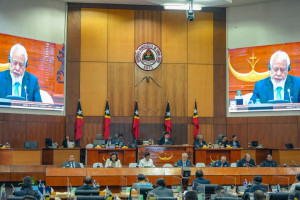
On Monday, November 9th, 2026, the 9th Constitutional Government, led by Prime Minister Kay Rala Xanana Gusmão and accompanied by members of the Executive, presented the 2027 General State Budget (GSB) law proposal to the National Parliament in Dili, with a consolidated global total of US$ 2.569 billion. The presentation marked the start of the parliamentary debate in general terms, which ran until November 11th, during which the Government’s main priorities and budgetary options for the coming year will be discussed.
Under the theme “Strengthening Resilience through Transformation: Diversifying the Economy for a Sustainable Future”, the 2027 draft budget aims to consolidate the national economy, improve public service delivery, create employment opportunities, and reduce dependence on petroleum revenues, in line with the Programme of the 9th Constitutional Government and the Strategic Development Plan 2011–2030.
Addressing Members of the National Parliament, the Prime Minister said: “Through this budget proposal, we aim to consolidate our economy, strengthen public service delivery, and expand opportunities for progress and well-being for Timorese families across the country.” He further emphasised that the Government's mission “is to manage the State's financial resources—substantial yet finite—with discipline, sustainability, transparency, and accountability, preparing the country not only for 2027 but also for the challenges of subsequent years in an increasingly uncertain and demanding world.”
The Head of Government acknowledged progress in infrastructure development and public services but warned of persistent poverty and inequality, particularly in rural communities. He noted that the non-oil economy grew by 4.3% in 2025 and that the proportion of the population living below the poverty line fell from 48.4% in 2014 to 37% in 2024, according to the recent Living Standards Survey.
Despite this progress, he stressed the need for more effective responses to family hardship, saying: “The Government has not lacked effort in combating inequality. But effort alone does not comfort those who suffer. We must do more and do better. The 2027 General State Budget is an expression of that very commitment.”
The budget proposal allocates US$2.487 billion to the Central Administration and US$ 56.1 million to the Special Administrative Region of Oe-Cússe Ambeno (RAEOA). The Social Security budget is estimated at US$186.55 million.
The consolidated global amount represents a 7.4% increase compared with the 2026 Rectified Budget. Public investment totals US535.3 million, of which US$ 505.8 million is allocated to development capital projects. Conversely, the allocation for goods and services has been reduced by 19.8% to US$550.3 million.
The Prime Minister explained that this option aims to prioritise productive investment and control operational expenditure. He also highlighted that the budget was fully prepared using a policy-led approach over a five-year horizon, linking financial allocations to programmes and expected results.
In this context, he stated that “every budget allocation is linked to a policy, a programme, and expected results. No expenditure will continue simply because it ‘has always been there’, as all spending will be subject to review.”
For 2027, the Government forecasts non-oil economic growth of 4.6% and inflation of around 1.8%, with these projections dependent on the capacity to implement public policy and on international economic developments.
Among the priorities presented, the Government proposes US$956.9 million for economic affairs, including infrastructure and the productive sectors. Agriculture receives US$37.8 million, a 21% increase from the previous budget, while tourism receives US$13.1 million, up 31%.
The budget also allocates US$244.8 million to new policies in the petroleum and mineral sector, including support for TIMOR GAP for the Kuda Tasi and Jahal projects and for advancing Greater Sunrise, as part of the strategy to leverage natural resources and promote economic diversification.
In infrastructure, allocations include US$345.7 million for roads and bridges, US$157.6 million for electricity, and US$23.5 million for water and sanitation. The Government intends to continue ongoing projects, improve maintenance of existing infrastructure, and enhance access to markets and public services.
In social sectors, the proposal foresees US$182.6 million for health, a 17% increase, and US$194.2 million for education, an 11% increase compared with 2026. Social inclusion receives approximately US$367 million, covering support for National Liberation Combatants, social security, and assistance to vulnerable families. Allocations also include US$24.7 million for school feeding and US$11.7 million for maternal and child support, primarily through the Bolsa da Mãe (Mother’s Allowance) programme.
Local development and decentralisation are also budget priorities, with US$148.1 million allocated to the 13 municipalities, US$22.9 million to the National Village Development Programme (PNDS – acronym in Portuguese), and US$33.8 million to the Integrated Municipal Development Programme (PIGD – acronym in Portuguese).
Regarding public financial sustainability, the Prime Minister emphasised the need to strengthen national productive capacity, increase domestic revenues, and improve the efficiency of public spending to progressively reduce reliance on the Petroleum Fund. For 2027, domestic revenues are projected at US$298.6 million, a 10% increase, while efficiency measures planned across 62 State entities are expected to deliver annual savings of US$53.6 million.
The Head of Government argued that the drawdowns from the Petroleum Fund must be directed towards investments that drive economic growth, enhance public services, and generate new revenue streams.
“Our justification for using these savings is clear: to invest in productive capacity and public services. But this creates an unavoidable obligation to demonstrate results, control costs, and develop new revenue streams. No future return can exempt us from this responsibility,” he stated.
The Prime Minister further stressed the need to continue public financial management reforms, improve revenue mobilisation, and ensure responsible resource management over the medium and long term. In this context, he noted ongoing preparations to introduce a Value Added Tax (VAT) at a proposed rate of 5%, starting in 2028, subject to approval by the National Parliament and the creation of the necessary implementation conditions.
“Protecting our national savings requires consistent decision-making over several years. The reforms embedded in this Budget must be implemented, and their outcomes must guide future choices,” he underscored.
As part of national responsibilities planned for 2027, the budget also includes the resources required for the presidential elections, the potential holding of two or three municipal elections, subject to structural readiness, and the initiation of logistical and infrastructure preparations for Timor-Leste’s ASEAN Chairmanship in 2029.
In the concluding section of his address, the Prime Minister reaffirmed the Executive's commitment to providing clarifications to Members of Parliament and to reviewing recommendations put forward during parliamentary debate. “Scrutiny is part of our responsibility to the Timorese People. This debate must serve to refine choices and strengthen outcomes,” he declared.
The Head of Government concluded with an appeal for public investment to deliver concrete benefits for the population: “Let us make 2027 a year in which a larger share of our investment translates into productive activity, in which more public services reach those who need them, and in which more Timorese families can see a secure future in their own country.”
The law proposal was submitted to the National Parliament on October 1st, 2026, and was then reviewed by parliamentary committees, which held hearings between October 13th and 23rd. The debate in general terms will continue through November 11th. After approval, the bill will proceed to detailed debate and voting, beginning on November 24. Once this phase is complete, the bill will undergo a final overall vote, after which it will be submitted to the President of the Republic for enactment.