





Prime Minister Calls for Strengthened Legal and Judicial Cooperation to Combat Online Fraud and Transnational Crime
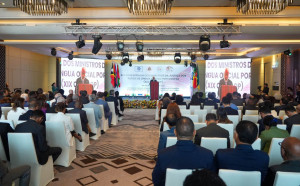
On October 27th, 2026, Prime Minister Kay Rala Xanana Gusmão presided over the ministerial session of the 19th Conference of Ministers of Justice of Portuguese-Speaking Countries (CMJPLOP – acronym in Portuguese), held in Dili. In his remarks, he advocated strengthening international legal and judicial cooperation to prevent and combat online fraud and other forms of transnational crime, and to protect citizens.
The session brought together ministers, heads of delegation, and representatives from Member States of the Community of Portuguese-Speaking Countries (CPLP – acronym in Portuguese), continuing the preparatory work begun on October 26th. The Conference is examining ways to deepen cooperation in crime prevention, criminal investigation, and international judicial cooperation in response to cross-border crimes that make use of digital technologies.
In his remarks, the Prime Minister highlighted the human and economic impact of online fraud, which can erode households' and businesses' savings and undermine security and confidence in the economy. He also drew attention to the link between some of these criminal networks and human trafficking, involving deceptive recruitment practices and coercion into illicit activities.
The Head of Government stated that “behind every instance of fraud, there is a person, a family, or a company that placed their trust in someone. The money involved may well be the result of years of work and savings,” and emphasised that, when faced with criminal networks operating across countries, no single authority has all the information needed to investigate and hold perpetrators accountable.
In this context, he advocated strengthening information sharing among authorities, preserving digital evidence, and coordinating investigations, as well as providing digital education for citizens—particularly those in vulnerable groups and individuals with less familiarity with technology.
The Prime Minister also highlighted the use of the International Legal and Judicial Cooperation Network of Portuguese-Speaking Countries to ensure up-to-date information, operational points of contact, and the rapid, secure transmission of requests for cooperation.
Another topic addressed was the circulation and authentication of public documents. Kay Rala Xanana Gusmão announced that Timor-Leste is preparing to accede to the Apostille Convention to simplify authentication procedures and facilitate the circulation of public documents between countries.
The Minister of Justice, Sérgio de Jesus Fernandes da Costa Hornai, also emphasised the need to strengthen institutions' capacity to prevent and investigate digital crimes and to deepen international legal cooperation. He noted that operations in Timor-Leste have uncovered evidence of human trafficking linked to online fraud, including deceptive recruitment and coercion into illicit activities.
The Minister also emphasised the importance of sharing best practices, professional training, and deepening international cooperation, stating that “Timor-Leste also intends to strengthen cooperation with the CPLP, ASEAN, the European Union, and international partners, to share experiences, improve professional training, and bolster judicial cooperation.”
The Conference also addresses the circulation and verification of notarial documents, continuing the work carried out in this area during the presidency of São Tomé and Príncipe.
The proceedings also include a discussion of the Dili Declaration, which seeks to establish common guidelines to deepen legal and judicial cooperation among Member States in the fight against transnational organised crime.
The 19th CMJPLOP is held under the theme “Strengthening Judicial Cooperation among CPLP Member States to Combat Transnational Organised Crime, Digital Fraud, and Illegal Gambling” and falls within Timor-Leste’s responsibilities as it holds the Pro Tempore Presidency of the CPLP.