




Government Reaffirms Commitment to the Preservation of Tais (traditional weave) and the Economic Empowerment of Women Weavers
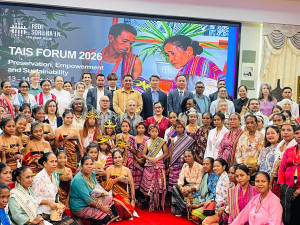
The Minister of Youth, Sports, Art, and Culture, Nelyo Isaac Sarmento, and the Secretary of State for Art and Culture, Jorge Soares Cristóvão, attended the opening of the 4th National Forum of the Soru Na’in Tais Network on Tuesday, October 13th, 2026, at the Nicolau Lobato Presidential Palace in Dili. The forum focused on strengthening the preservation, capacity-building, and sustainability of Tais production in Timor-Leste.
The opening ceremony was presided over by the President of the Republic, José Ramos-Horta, and brought together around 250 participants, including women weavers from across the country, Government representatives, civil society organisations, and development partners, to discuss measures to preserve the traditional knowledge associated with Tais while strengthening its contribution to income generation and local economic development.
In his address, Minister Nelyo Isaac Sarmento emphasised the need to ensure the transmission of traditional weaving knowledge and techniques to younger generations and reaffirmed the Government’s commitment to the preservation and promotion of Tais.
The Government has been developing initiatives to preserve and promote Tais through the Secretariat of State for Art and Culture, in collaboration with organisations and networks of women weavers, including Timor Aid, the Alola Foundation, and the Soru Na’in Network. In April this year, the Secretariat of State for Art and Culture signed a Memorandum of Understanding with Timor Aid and the Alola Foundation to strengthen support for Soru Na’in Network associations across the country, promote the sustainability of Timorese handicrafts, and improve access to national and international markets for these products.
The Forum also offers an opportunity to enhance coordination among public institutions, partner organisations, and the weavers themselves on issues including production quality and sustainability, market access, the economic valuation of women weavers’ work, and the continuity of traditional knowledge.
At the start of the meeting, President José Ramos-Horta argued that preserving this heritage must be linked to improving the economic conditions of the women who produce it, emphasising the importance of fair remuneration and ensuring that the commercialisation of tais respects its cultural authenticity and directly benefits women artisans.
Tais plays a central role in the cultural identity and social life of Timorese communities, being used in traditional ceremonies, celebrations, and other significant moments of community life. The patterns, colours, and production techniques display distinctive characteristics across the country’s regions, reflecting the cultural diversity of Timor-Leste.
In December 2021, traditional Tais of Timor-Leste was inscribed by UNESCO on the List of Intangible Cultural Heritage in Need of Urgent Safeguarding. Among the challenges identified for its preservation are the declining number of women weavers, reduced interest among younger generations in learning traditional techniques, the loss of certain motifs and production methods, and limited market access.
In this context, the 4th National Forum of the Soru Na’in Tais Network aims to contribute to a joint response to these challenges by reconciling the safeguarding of cultural heritage with the empowerment of women weavers, the recognition of their work, and the development of sustainable economic opportunities for communities.