





Government and November 12th Committee Lay the Foundation Stone for Sebastião Gomes Memorial
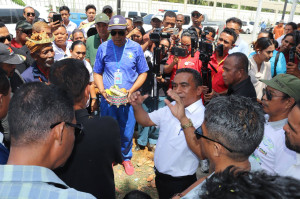
On October 2nd, 2026, at the Santa Cruz Cemetery in Dili, the Minister of National Liberation Combatants’ Affairs, Gil da Costa Monteiro “Oan Soru”, attended the foundation-stone-laying ceremony for the Sebastião Rangel Gomes Memorial, paying tribute to the young man associated with the Clandestine Front of the Timorese Resistance, whose death in October 1991 preceded the events of the November 12th Massacre.
The project, titled “Design and Construction of the Historical Preservation and Sebastião Gomes Memorial Project (Santa Cruz)”, is being implemented with the participation of the Dili Municipal Authority, the November 12th Committee, and the Ministry of National Liberation Combatants’ Affairs.
The project, valued at US$93,500, is due for completion by December 2026.
The project also provides for the transfer of Sebastião Gomes’s remains from their current grave to a new location near the entrance to Santa Cruz Cemetery, following coordination among the Government, the November 12th Committee, and the family. The Minister said this solution will increase the memorial’s visibility and make it easier to pay tribute to Sebastião Gomes.
Gil da Costa Monteiro thanked the November 12th Committee and the family of Sebastião Gomes for their cooperation in finding a solution for the project, emphasising the importance of transferring the remains to preserve the memory of the 1991 events.
“We will transfer the remains of our brother Sebastião Gomes to this site, near the entrance to Santa Cruz, to honour his memory, particularly on November 12th. As the grave is far from the cemetery entrance, some people may not be able to reach it. Here, even those who do not come to lay flowers can pass by and pay tribute. This is part of valuing the history of the national liberation struggle,” he stated.
During the ceremony, the Minister also emphasised the need to preserve the testimonies of participants in the national liberation struggle and issued a special call to the survivors of November 12th to record in writing their experiences and participation in the resistance.
Gil da Costa Monteiro warned that part of this memory could be lost if the testimonies of those who lived through this period remain solely oral. “Tomorrow or the day after, when we are no longer here, if people cannot read our history either, we will have a major problem. Therefore, you must write your history, because writing is important,” he added.
The Minister also stressed that the recognition of those who died during the struggle for independence does not depend on the location of their remains or on whether they are recovered. “Regardless of whether the remains are found or not, we must honour and pay our tribute to those who gave their lives,” he declared.
The foundation-stone-laying ceremony included a traditional ritual led by a representative of the lia-na’in (literally “master of the word – a traditional cultural authority).
The Minister also called on the company responsible for the work to comply with the contractual terms, particularly the execution deadline and the quality of construction.
The Sebastião Gomes Memorial aims to preserve his memory and highlight his role in the events preceding the November 12th, 1991, Massacre and in the national liberation struggle.