




Health Minister Advocates Strengthened Pandemic Preparedness and International Cooperation at the United Nations General Assembly
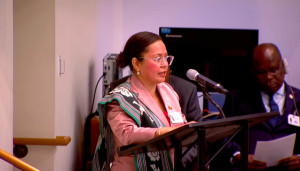
On September 25th, 2026, in New York, the Minister of Health, Élia A. A. dos Reis Amaral, participated in the High-Level Meeting of the 81st Session of the United Nations General Assembly (UNGA 81) on Pandemic Prevention, Preparedness, and Response. She presented Timor-Leste’s progress in developing national capacities to respond to public health emergencies and advocated for international cooperation grounded in the principles of equity and solidarity.
The meeting brought together representatives of Member States and international organisations to review commitments made since the first meeting on this subject in 2023, identify persistent gaps, and promote a more coordinated international response to future pandemics and other public health emergencies.
In her remarks, the Minister of Health emphasised that, as a small island developing state, Timor-Leste relies heavily on robust national institutions and effective mechanisms for the early detection of threats, enabling an adequate response to public health emergencies.
In this context, Élia Amaral highlighted the training of the first group of 40 Timorese health professionals in field epidemiology—completed in June 2025—as part of efforts to strengthen national capacity in this area. The Minister explained that the Government is now committed to translating the skills acquired into effective, reliable health services by developing laboratory capacity, community-based information and alert systems, and emergency response coordination, while ensuring the continuity of essential medical care during crises.
Timor-Leste has also reaffirmed its support for the International Health Regulations, the World Health Organisation (WHO) Pandemic Agreement, and the One Health approach, which recognises the interdependence of human, animal, plant, and environmental health. In this context, the Government has promoted greater coordination across national sectors through initiatives to improve surveillance, early detection, and joint responses to health threats.
Élia Amaral also advocated greater international cooperation through partnerships between laboratories and the exchange of health professionals, as well as equitable access to vaccines, diagnostic tools, and treatments, in line with public health needs.
The Minister's participation took place just a few weeks after Dili hosted the 79th Session of the WHO Regional Committee for South-East Asia—held from September 7th to 10th, 2026 and chaired by Élia Amaral—which brought together the region's Member States to discuss shared health priorities and challenges.
Timor-Leste's presence on the United Nations' high-level agenda on September 25th also included initiatives focused on climate finance, peacebuilding, intercultural dialogue, and combating intolerance.
The Special Envoy and Ambassador for Climate Affairs, Adão Barbosa Soares, attended the high-level event “Broadening the funding base: the urgent need to increase funding for loss and damage”, organised by the Government of the Philippines and the Secretariat of the Fund for Responding to Loss and Damage (FRLD).
The initiative brought together government representatives and other stakeholders to review the Fund's operationalisation and discuss ways to increase and accelerate the mobilisation of resources for developing countries particularly vulnerable to the effects of climate change. The discussion also sought to strengthen political support for increased financing flows and to contribute to preparations for COP31 and upcoming international initiatives in this area.
Also on September 25th, the Director-General for Multilateral Affairs, Sebastiana Barros, represented Timor-Leste at the high-level meeting of the Group of Friends of the United Nations Alliance of Civilisations (UNAOC), which was dedicated to promoting dialogue, trust, and peaceful coexistence in an international context marked by conflict, tensions, and rising intolerance.
In her intervention, Sebastiana Barros highlighted Timor-Leste’s experience in peacebuilding and reconciliation, emphasising the importance of the participation of women, local leaders, religious communities, and—in particular—of young people in building peaceful and inclusive societies.
The representative from Timor-Leste advocated for locally led initiatives that equip young people with the tools to challenge harmful stereotypes, use digital spaces responsibly, and participate directly in designing programmes that promote dialogue and peaceful coexistence.
Sebastiana Barros also called for intensified efforts to protect places of worship and combat religious intolerance, as well as for extending the Alliance of Civilizations' initiatives to smaller states with more limited resources, emphasising that lasting peace requires dialogue, inclusion, and the gradual building of trust among different communities.