


Timor-Leste’s Participation in the UNGA Highlights Peace, Multilateral Cooperation and Sustainable Development
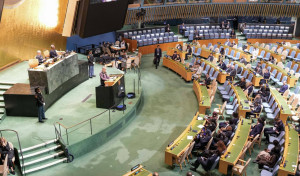
The Minister of Foreign Affairs and Cooperation, Bendito dos Santos Freitas, continued Timor-Leste’s diplomatic agenda in New York on September 23rd and 24th, 2026, within the scope of the High-Level Week of the 81st Session of the United Nations General Assembly (UNGA 81), participating in ministerial and high-level meetings and holding bilateral meetings. The Minister also accompanied President José Ramos-Horta in presenting Timor-Leste’s national statement before the General Assembly.
On September 24th, Minister Bendito Freitas attended the High-Level Ministerial Meeting of the Global Alliance for the Implementation of the Two-State Solution, where he reaffirmed Timor-Leste’s support for the Palestinian people’s right to self-determination and for the establishment of a viable and sovereign Palestinian state coexisting with Israel in peace and security.
In his statement, he emphasised the protection of civilians, humanitarian access, the strengthening of Palestinian institutions, and respect for international law. He also argued that a lasting peace must safeguard the rights, security, and dignity of Palestinians and Israelis.
On the 24th, the Minister also participated in the g7+ High-Level Summit, which focused on defining concrete mechanisms to promote stability, self-reliance, and resilience. Bendito Freitas presented three priorities: the creation of a structured peer-exchange mechanism for dialogue and mediation; the strengthening of the Rapid Response Advisory Centre; and greater use of the g7+ diplomatic presence to promote coordinated positions within multilateral institutions.
The Minister also attended the Annual Ministerial Meeting of the Foreign Ministers of the Least Developed Countries, themed “Building Resilient and Connected Least Developed Countries: Accelerating the Implementation of the Doha Programme of Action through Partnerships”.
In his address, he highlighted the effects of climate change, debt vulnerability, and the financing challenges faced by Least Developed Countries. He advocated strengthening predictable climate financing and highlighted three areas of Timor-Leste’s strategic reforms aligned with the Doha Programme of Action: human capital, economic diversification, and connectivity. In this context, he cited investments in education and health, the Blue Economy initiative, and enhanced digital connectivity through the international undersea fibre-optic cable.
As part of Timor-Leste’s agenda with regional partners, Bendito Freitas also attended the ASEAN–Gulf Cooperation Council Foreign Ministers’ Meeting. The Minister advocated strengthening cooperation across trade and investment, energy, sustainable infrastructure, digital connectivity, food and water security, tourism, education, and human capital development, and expressed support for ongoing work towards a possible ASEAN–Gulf Cooperation Council Free Trade Agreement.
The bilateral agenda included a meeting with Portugal’s Minister of State and Foreign Affairs, Paulo Rangel. The two Ministers assessed the development of relations between Timor-Leste and Portugal, and the progress made since the recent Council of Ministers meeting of the Community of Portuguese Language Countries, held in Dili. They also addressed bilateral coordination within the CPLP framework and in multilateral forums, including during Portugal’s upcoming term on the United Nations Security Council, which begins in January 2027.
During the High-Level Week, Bendito Freitas also held bilateral meetings with officials from various countries. Among them, he met with Liechtenstein’s Vice Prime Minister and Minister of Foreign Affairs, Environment and Culture, Sabine Monauni, to discuss multilateralism, international law, and the role of multilateral institutions in protecting the interests of small states.
These activities continued the agenda set during the first days of the High-Level Week, when the Minister participated in the Summit of Partners for Multilateralism and in a debate on the Law of the Sea, and held bilateral meetings with the Foreign Ministers of Ukraine and the Maldives.
As part of the national delegation’s participation, President José Ramos-Horta delivered Timor-Leste’s national statement before the 81st Session of the United Nations General Assembly on September 23rd, accompanied by the Minister of Foreign Affairs and Cooperation, Bendito dos Santos Freitas, and other members of the delegation.
In his statement, the Head of State addressed current conflicts and humanitarian crises and advocated dialogue and diplomacy to promote peace. Regarding the situation in Gaza and the West Bank, he reaffirmed Timor-Leste’s support for the Two-State Solution, which he considered the only viable path to enabling Israelis and Palestinians to live in peace.
President José Ramos-Horta also advocated strengthening the multilateral system and reform of the United Nations Security Council to ensure greater representation for developing countries and historically underrepresented regions. On climate change, he reaffirmed the principles of climate justice and called for greater access to financing, adaptation support, technology transfer, and capacity building for the most vulnerable countries.
The Head of State further addressed the challenges posed by artificial intelligence and emerging technologies, advocating the active participation of developing countries in their governance and development. He also noted Timor-Leste’s accession to ASEAN and the national commitment to contributing to a united, people-centred, and resilient ASEAN, while maintaining balanced and constructive relations with its neighbours, major powers, and development partners.