





Government Promotes Awareness of the Blue Economy and Launches Lenuk-Tasi in Liquiçá
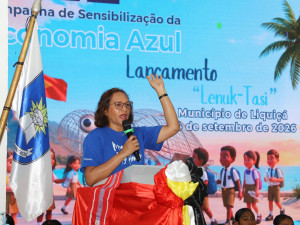
The Minister of Education, Dulce de Jesus Soares, attended, on September 14th, 2026, in Liquiçá, the launch of the Lenuk-Tasi (Sea Turtle), an art structure designed to collect plastic bottles, as part of the Government’s awareness campaign on the Blue Economy and the protection of the marine environment.
The initiative, led by the Land and Maritime Borders Office and coordinated with the Ministry of Education and the Liquiçá Municipal Authority, brought together representatives of public institutions, schools, and partner organisations, along with approximately 700 secondary school students.
Created by a Timorese artist, the Lenuk-Tasi represents a sea turtle and serves as a collection point for plastic bottles, which are then recycled and reused. The installation seeks to encourage students, young people, and the community to adopt responsible waste disposal practices and to help reduce marine plastic pollution.
The initiative forms part of a series of public art installations, featuring representations of marine animals, planned for various locations across the country. It follows the 2024 launch of the Ikan Azul (Blue Fish) in Dili by the Prime Minister, Kay Rala Xanana Gusmão.
During the activity, the Minister of Education highlighted the role of schools in educating and raising awareness among younger generations about the protection of oceans and natural resources. “Protecting the sea is also something that is learned. And it must be learned from an early age,” stated Dulce de Jesus Soares.
The Minister explained that topics related to environmental, oceanic, and natural resource protection are addressed throughout the Basic Education curriculum (Primary and Secondary School, Years 1-9). Schools also utilise educational resources produced by the Land and Maritime Borders Office, including the book Meu Mar, O Meu Timor, to promote ocean literacy and knowledge of marine biodiversity.
Regarding the Lenuk-Tasi, the Minister stated that “every bottle placed inside this turtle is a bottle that was not left abandoned on the ground, not washed by rain into a ditch, not carried into a stream, and not ending up in our sea.”
The activity featured a presentation on Timor-Leste’s Blue Economy Policy, an informative video screening, a question-and-answer session, and an exhibition of sustainable fisheries products and local handicrafts.
The Liquiçá Centre for Learning and School Training (CAFE) also presented a cooperation initiative with the company Caltech, linking environmental education with the practical application of recycling to collect plastic waste accumulated at the school and convert it into reusable products.
Inês Araújo Gonçalves, the Lead Coordinator of the Blue Economy Unit at the Land and Maritime Borders Office, emphasised the need to involve different sectors of society in implementing the Blue Economy Policy. “The Government alone cannot implement this policy. Support from all entities, including the media, is necessary to disseminate information about the Blue Economy,” she stated.
The President of the Liquiçá Municipal Authority, Paulino Ribeiro, urged students to dispose of waste in appropriate locations and to contribute to environmental protection. The Municipal Authority also plans to extend awareness-raising activities to the sucos, in coordination with local authorities and communities.
The Blue Economy awareness campaign is set to continue in the municipalities of Aileu, Manatuto, Baucau, and Lautém, and subsequently in the remaining municipalities, with activities aimed at school communities to promote the protection of marine and coastal resources and responsible waste management practices.