




Government Steps Up Brucellosis Prevention and Control Based on Results of BRUCE-TL Project
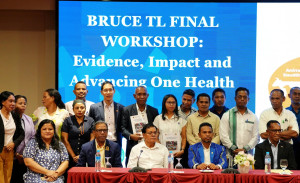
The Vice-Minister for Institutional Strengthening of Health, José dos Reis Magno, and the Secretary of State for Livestock, José Vieira de Araújo, attended the final workshop of the BRUCE-TL project in Dili, on September 15th, 2026, which presented research findings on brucellosis and strengthened collaboration between the human and animal health sectors in Timor-Leste.
The workshop, themed “Evidence, Impact and Advancing One Health Collaboration in Timor-Leste”, brought together representatives from the Ministry of Health, the Ministry of Agriculture, Livestock, Fisheries and Forestry, the Menzies School of Health Research, the Bobonaro Municipal Authority, human and animal health professionals, researchers, partners, and other relevant entities.
At the opening of the workshop, Vice-Minister José dos Reis Magno stated that “holding this workshop demonstrates that, to respond to public and animal health challenges, we need cooperation, dialogue, scientific evidence, and shared responsibility”.
Brucellosis is an infectious disease caused by bacteria of the genus Brucella and is a zoonotic disease, meaning it can be transmitted from animals to humans. In cattle, it primarily affects the reproductive system and can cause abortions, infertility, retained placenta, the birth of weak calves, and reduced production.
During the workshop, the National Directorate of Veterinary Services presented data on tests conducted in 2023 on 1,046 cattle in the Bobonaro and Covalima Municipalities and the Special Administrative Region of Oe-Cússe Ambeno, of which 505 tested positive for brucellosis. These data refer to the animals and areas tested and do not constitute an estimate of the disease's prevalence across the national cattle population.
The Vice-Minister emphasised that “this figure demonstrates that, in some areas, brucellosis may constitute a problem for animal health and livestock production”, adding that “available evidence shows that brucellosis is present in different areas and that continuous surveillance is necessary to improve understanding of the disease’s distribution and evolution in our country”.
José dos Reis Magno therefore advocated continuing research and surveillance in the human and animal health sectors to obtain more comprehensive data on the extent of the disease in Timor-Leste.
The BRUCE-TL project, implemented by the Menzies School of Health Research in collaboration with the Ministry of Health and the Ministry of Agriculture, Livestock, Fisheries and Forestry, aims to identify risk factors for the transmission of brucellosis and to support the development and implementation of evidence-based control measures through a participatory approach and the “One Health” principle.
As part of the project, a study in Maliana involving 253 cattle farmers and 22 animal health professionals identified a still limited level of knowledge about brucellosis among farmers, as well as several practices likely to increase exposure to the disease.
The Vice-Minister stated that these findings “demonstrate that our response must take into account the actual practices of communities and not just theory” and called for strengthened surveillance and diagnosis; greater awareness among farmers of the risks associated with abortions, placentas, and other potentially contaminated materials; safe animal-handling practices; food safety; and vaccination and other control measures grounded in scientific evidence.
“Preventing brucellosis is everyone’s responsibility. We have evidence that this disease affects animals in our territory, including in Bobonaro, Covalima, and Oe-Cússe,” said José dos Reis Magno.
The Secretary of State for Livestock, José Vieira de Araújo, also emphasised the need for a coordinated response across sectors, stating that brucellosis “is not merely an animal health issue, but also has a direct link to public health, livestock productivity, and community well-being.” He therefore advocated involving various institutions and using scientific evidence to guide decision-making.
José Vieira de Araújo also highlighted cooperation with the Menzies School of Health Research and the contributions of veterinary services, researchers, students, and communities to implementing BRUCE-TL. He advocated continuing this collaboration to strengthen national capacities and support the development of evidence-based policies and programmes for the livestock sector.
In this context, the “One Health” approach seeks to coordinate human, animal, and environmental health sectors. Consequently, preventing and controlling brucellosis involves veterinary and health services, national and municipal authorities, researchers, laboratories, livestock producers, communities, and development partners.
The research conducted under BRUCE-TL has already begun to translate into on-the-ground measures. On September 4th, the Secretariat of State for Livestock, in partnership with the Menzies School of Health Research and the National Directorate of Veterinary Services—and with the participation of Animal Health students from the National University of Timor Lorosa’e—launched a bovine brucellosis vaccination programme in the hamlet of Genuhan, Lahomea village, Maliana Administrative Post, Bobonaro Municipality.
The vaccination programme is based on evidence and technical recommendations from BRUCE-TL and includes animal identification, monitoring, and evaluation activities. Australia’s Department of Agriculture, Fisheries and Forestry supports this initiative by funding the procurement of brucellosis vaccines, animal ear tags, and technical equipment; preparing animal handling facilities; and training involved teams.
Preventing transmission to humans also requires precautions when in contact with animals. The public—especially livestock farmers, workers, and others who handle cattle—must avoid unprotected direct contact with placentas, foetuses, blood, secretions, and other materials resulting from births or abortions, use appropriate protection when handling such materials, and ensure their safe disposal.
It is also recommended to avoid consuming unpasteurised milk and to ensure that meat and other animal products are thoroughly cooked before consumption. Individuals exposed to potentially infected animals or materials who develop fever, sweating, fatigue, weakness, or muscle and joint pain should seek medical attention and inform healthcare professionals of their contact with animals.
During the workshop, the Secretariat of State for Livestock and the Menzies School of Health Research signed a Memorandum of Understanding to strengthen cooperation and collaboration between the two institutions. The agreement provides for enhanced knowledge and scientific evidence sharing, technical capacity building, and support for implementing animal health programmes in Timor-Leste.
The signing of the Memorandum builds on the collaboration developed under BRUCE-TL. It establishes a foundation for cooperation between the Secretariat of State for Livestock and Menzies in areas such as research, technical capacity building, and animal health.
The final workshop provided an opportunity to evaluate the results of BRUCE-TL, share evidence and lessons learned during the project’s implementation, and analyse the continuation of brucellosis surveillance, prevention, and control measures through collaboration between the human and animal health sectors.