






Government establishes Interministerial Committee on Cybersecurity and the Digitalisation of State Services
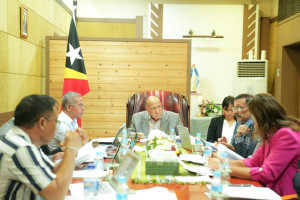
The Prime Minister, Kay Rala Xanana Gusmão, issued an order, signed in Dili on August 6th, 2026, establishing the Interministerial Committee on Cybersecurity and the Digitalisation of State Services (CICDE – acronym in Portuguese), which is responsible for coordinating public policies and initiatives in these areas.
The Committee is chaired by the Minister of the Presidency of the Council of Ministers, with the Minister of Transport and Communications serving as vice-chairman.
The CICDE also comprises the Ministers of Justice, the Interior and State Administration, together with representatives of the National Strategic Intelligence Service, TIC Timor, the Forensic Criminal Investigation Police, the Financial Intelligence Unit of the Central Bank of Timor-Leste, the National Police of Timor-Leste, and the National Communications Authority.
Technical coordination will be provided by the Director-General of the National Strategic Intelligence Service, with assistance from the Executive Director of TIC Timor. The Presidency of the Council of Ministers will provide administrative and documentary support.
The establishment of the CICDE follows the submission to the National Parliament on July 31st, 2026, of a proposal for legislative authorisation to approve an integrated legislative package on cybersecurity. The proposal was approved by the Council of Ministers on July 22nd, presented by the Minister of the Presidency of the Council of Ministers, Agio Pereira, and then submitted to the National Parliament by the Prime Minister.
The legislative package covers the National Cybersecurity Strategy, the legal framework for national cyberspace security, the framework for digital services, and the criminal and criminal procedural framework applicable to offences committed in the digital environment, including rules governing the collection, preservation, and use of electronic evidence.
The initiative aims to provide Timor-Leste with a coherent legal framework to prevent, investigate and combat cybercrime, protect critical infrastructure, and enhance the security of citizens, businesses, and institutions in the digital environment.
The new Committee succeeds the Interministerial Cybersecurity Group, established in October 2025 to coordinate the protection of national critical systems and infrastructure – with a particular focus on the Timor-Leste South Submarine Cable (TLSSC) – and to facilitate international cooperation in this area.
The structural change responds to the advancing digitalisation of public administration and the State’s growing use of cyberspace. The Committee’s remit will now, in an integrated manner, cover cybersecurity, the regulation of cyberspace, data protection, the prevention and prosecution of cybercrime, and the digitalisation of government services.
The CICDE will ensure political, legal, institutional, and technical coordination of these matters. The Committee will carry out functions of coordination, guidance, liaison, monitoring, and oversight, without replacing the ministries, departments, and other public bodies responsible for implementing the projects.
Its remit includes defining common priorities, preparing a consolidated public policy document and a phased legislative plan, and coordinating proposals on cybersecurity, data protection, critical information infrastructure, cybercrime, and electronic evidence.
The Committee will also coordinate proposals on e-government, digital identity, electronic signatures and trust services, data governance, interoperability, secure information sharing, and the digital processing of administrative procedures.
The CICDE is also expected to define common principles, standards and requirements for the State’s digital systems and services, with a view to preventing duplication of investment, platform incompatibility, data fragmentation, and excessive reliance on external suppliers.
The order also sets out common criteria for assessing the risks associated with private entities that supply digital systems, equipment, infrastructure, or services to the State. Proposals for support from development partners will likewise be subject to political and strategic assessment, considering national sovereignty, the Government’s priorities, the sustainability of the solutions, and the risks of technical, financial, or political dependence.
The CICDE will ordinarily meet once a month, report monthly to the Prime Minister, and submit policy proposals, legislative initiatives, draft legislation, and reports on the implementation of its work to the Council of Ministers.