





Timor-Leste Marks International Day for the Elimination of Violence against Women with March for Equality and Launch of the 16 Days of Activism Campaign
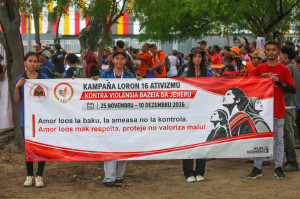
On November 25th, 2026, the State Secretariat for Equality (SEI), in collaboration with civil society organisations and development partners, marked the International Day for the Elimination of Violence against Women by launching the 16 Days of Activism Against Gender-Based Violence Campaign. The campaign, which runs until December 10th, International Human Rights Day, has the national theme “Promoting and ensuring access to justice, protecting survivors, and ending impunity for violence against women and girls”.
A March for Equality, which began on the campus of the Dili Institute of Technology (DIT) and concluded at Bebora Garden in Dili, marked the opening of the campaign. The initiative brought together representatives of State institutions, including the FALINTIL – Timor-Leste Defence Force (F-FDTL), development partners, civil society organisations, university students, and other community members, to raise public awareness and collectively mobilise to prevent and eliminate all forms of violence against women and girls.
Among the awareness messages disseminated by the State Secretariat as part of the campaign, the call to build relationships based on respect and to reject abusive behaviour stands out: “True love does not harm, threaten, or control. True love is respecting, protecting, and valuing one another!” The campaign also highlights the importance of breaking the silence in the face of violence, supporting victims without judgment, and promoting safe and inclusive environments across family, professional, educational, public, and digital spaces, including for women and girls with disabilities.
On the morning of the same day, before the detailed debate and vote on the Draft Law on the General State Budget for 2027 began, members of the Government and Members of the National Parliament observed a minute of silence in honour of young Palomita Gusmão Guterres, who lost her life in Dili on November 18th.
The moment of tribute also paid respects to all victims of violence in Timor-Leste, particularly women, young people, and children, and expressed sorrow and solidarity with the bereaved families.
Following the death of Palomita Gusmão Guterres, an 18-year-old student at the Dili Institute of Technology, the State Secretariat for Equality issued a press release on November 20th in which it strongly condemned the crime, classified it as femicide, expressed its condolences and solidarity to the victim’s family, and called on the competent authorities to ensure a rigorous, complete, and transparent investigation, as well as swift, impartial, and professional handling of the judicial proceedings in accordance with existing legislation.
“Justice for Palomita is justice for all women,” stated the Secretary of State in the press release, in which she expressed her commitment to monitor the investigation and justice process and warned of the need to recognise and combat behaviours of harassment, threats, control, and aggression at an early stage, before they assume fatal consequences.
The State Secretariat for Equality also called on local authorities and communities to speak out against violence and report it to the competent authorities, particularly the National Police of Timor-Leste (PNTL). It further underscored the importance of involving men and young people in preventing violence, rejecting abusive behaviour, and fostering relationships grounded in respect and equality.
As part of government measures to prevent and respond to gender-based violence, the State Secretariat announced the launch of the Safe City for All Programme in collaboration with the Municipality of Dili. In parallel, the Government, through the Ministry of Higher Education, Science and Culture, continues to implement the Safe Campus Programme in universities. Both initiatives aim to create safe environments for women and girls through cooperation among public institutions, educational institutions, and communities.
Civil society organisations and development partners also support the national campaign, joining efforts to promote access to justice, protect victims and survivors, and combat impunity. The initiative reinforces collective responsibility for preventing and eliminating gender-based violence and underscores the importance of safety, dignity, and protecting the rights of women and girls to support the well-being of families and communities.
Preparations for the campaign included coordination meetings organised by the State Secretariat for Equality in November, aimed at defining the national theme and coordinating activities for the 16 days of activism.
During this period, the State Secretariat for Equality calls for the active participation of all State institutions, civil society organisations, development partners, and communities in concrete actions to prevent and combat violence against women and girls, with a view to building a just, inclusive, safe society free from violence and discrimination.