





Prime Minister Highlights Teachers' Role in Shaping Timor-Leste's Future
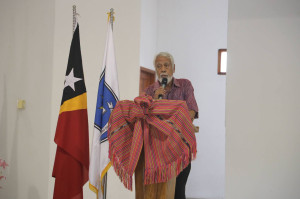
On October 27th, 2026, Prime Minister Kay Rala Xanana Gusmão attended the National Commemoration Ceremony for Education Month and World Teachers' Day, held at the Ian Martin Hall of the National Institute for the Training of Teachers and Education Professionals (INFORDEPE – acronym in Portuguese) in Dili. This year’s celebration also coincided with the 60th anniversary of the adoption of the UNESCO and International Labour Organisation (ILO) Recommendation concerning the Status of Teachers.
The ceremony was attended by the Minister of Education, Dulce de Jesus Soares; the Secretary of State for General Secondary Education and Technical-Vocational Secondary Education, Domingos Lopes Lemos; and representatives from educational and teacher-training institutions, development partners, educators, and students.
In his address, the Prime Minister stated that “education is the foundation for everything we wish to build for our future” and highlighted the role of teachers in shaping new generations. “Teachers are agents of transformation, present day after day in the lives of our children and young people. They therefore play an irreplaceable role in shaping new generations and in building the nation.”
Xanana Gusmão recalled that the education sector had to rebuild “the educational system, infrastructure, curricula and teaching materials, teacher training, and the very management and culture of schools,” and asserted that “without quality education, independence fails to fulfil its promise. And without qualified and valued teachers, development cannot take root, nor can it translate into concrete improvements in the lives of our people.”
The Head of Government reaffirmed commitments to “strengthen initial and ongoing teacher training,” “progressively improve working conditions for educators, especially in rural and remote areas,” and “invest in school infrastructure that is more dignified and functional.” He also highlighted the promotion of inclusive education, the responsible use of new technologies to support learning, and the strengthening of management, evaluation, and monitoring across the education system.
Regarding the valuation of the teaching profession, the Prime Minister stated that “it is not enough to ‘recognise’ and ‘thank’ you for your dedication to society just once a year. The best way to express gratitude is to value your profession in a concrete, consistent, and meaningful manner.” He added that “recognition alone is not enough; it is necessary to ensure greater respect for your rights and more support in the fulfilment of your duties.”
In light of social, technological, economic, and cultural transformations, the Head of Government noted that “artificial intelligence, digital technologies, and learning platforms—all of these bring enormous opportunities, but also significant challenges.” He argued that “technology should serve the purpose of learning and human development, but it can never, under any circumstances, replace the essential role of the teacher in guiding, educating, and supporting students.”
The celebration took place under the overarching theme “Valuing, Protecting, and Strengthening the Status of the Teaching Profession in a Rapidly Changing World,” with the specific theme “The Teacher as an Agent of Transformation: Role, Competencies, and Responsibilities in Building the Timorese State.” The initiative also marked the 60th anniversary of the 1966 Recommendation concerning the Status of Teachers — adopted by UNESCO and the ILO — which established international benchmarks for teachers’ rights and responsibilities, as well as for their training, recruitment, employment, and teaching and working conditions.
The Minister of Education, Dulce de Jesus Soares, stated that “this theme highlights the vital need to protect teachers’ rights, improve working conditions, address the shortage of educators, and confront current challenges, including digital transformation and climate change.”
Regarding the adaptation of the education system to technological change, the Minister added that “teachers are the heart of this national transformation. Through modern and creative methodologies, they prepare our young people to compete on a global scale.”
For his part, the Secretary of State for General Secondary Education and Technical-Vocational Secondary Education, Domingos Lopes Lemos, highlighted the responsibility of teachers in the development of children and young people, stating that “a teacher is an agent of transformation. When we look at a stone that has yet to take shape, someone with the necessary knowledge is required to transform it into something of value. The same applies to a newborn child, who is like a blank slate. It is the teacher’s role to provide guidance, offer instruction, and help children develop their knowledge, abilities, and character.”
Addressing teachers directly, the Prime Minister urged them “not to give up on our children and young people — even when conditions are less than ideal and resources are lacking.” He added that “a teacher can change a life. By changing one life, they can change a family, a community, and even an entire country.”
In his closing remarks, Prime Minister Xanana Gusmão expressed his gratitude to “all the teachers in our country,” acknowledged their role “in building the State and the Nation,” and reaffirmed “the Government’s commitment to working hard to improve the quality of education.”