





Timor-Leste Advocates Greater Access to Climate Finance for Vulnerable Nations
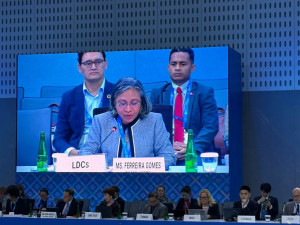
On October 13th, 2026, in Bangkok, Thailand, the Vice-Minister of Foreign Affairs and Cooperation, Jesuína Maria Ferreira Gomes, attended the inaugural Xingu Finance Talks, a high-level roundtable focused on solutions to improve climate-action financing.
The COP30 Presidency organised the initiative as part of the Veredas Dialogue, convening government representatives, international financial institutions, the private sector, and the academic community at the Queen Sirikit National Convention Centre.
The Xingu Finance Talks were established by a decision of the seventh session of the Conference of the Parties serving as the meeting of the Parties to the Paris Agreement (CMA 7), held in Belém, Brazil, in November 2025, as an annual high-level platform to promote the exchange of perspectives and to identify practical solutions to the challenges and opportunities associated with implementing Article 2(1)(c) of the Paris Agreement and with its complementarity with Article 9.
These provisions address, respectively, the need to align financial flows with a pathway towards low greenhouse-gas emissions and climate-resilient development, and the provision of climate finance for developing countries.
In this first edition, discussions centred on two priority areas: expanding fiscal space for climate action investments and reducing the cost of capital through risk-sharing mechanisms and guarantees.
Speaking on behalf of the Least Developed Countries (LDC) Group, Vice-Minister Jesuína Maria Ferreira Gomes set out these countries' priorities and emphasised that climate finance must help protect populations, strengthen resilience, and support sustainable development.
The Vice-Minister argued that financing mechanisms should reduce vulnerabilities rather than exacerbate them, create opportunities without increasing debt burdens, and deliver tangible results for the populations and communities most affected by climate change.
Jesuína Maria Ferreira Gomes also emphasised the need to ensure that climate finance is accessible, affordable, and responsive to the specific circumstances of the most vulnerable countries, particularly the Least Developed Countries, so they can build adaptive capacity and pursue climate-resilient development models.
On October 11th, a technical workshop preceded the high-level roundtable and focused on identifying practical solutions in the two priority areas. The outcomes of the Xingu Finance Talks are expected to inform the Veredas Dialogue's work on implementing the Paris Agreement's financial provisions.
The position presented at the Xingu Finance Talks aligns with Timor-Leste's position in other international forums on climate change and sustainable development. On October 13th, at the Second Committee of the 81st Session of the United Nations General Assembly in New York, Timor-Leste also advocated strengthening climate finance, technology transfer, and national capacities, as well as international support tailored to the circumstances of the most vulnerable countries.