


Ministry of Education Advances the Revision of the Senior Secondary School Curriculum with Support from SEAMEO and UNESCO
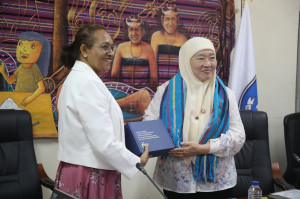
On October 5th, 2026, in Dili, the Ministry of Education initiated a series of meetings and working sessions with a delegation from the Southeast Asian Ministers of Education Organisation (SEAMEO) and the UNESCO Regional Office in Jakarta to develop the new curriculum framework for Timor-Leste’s general senior secondary and vocational secondary education.
The SEAMEO delegation is led by Habibah Abdul Rahim, Director of the organisation’s Secretariat, who is in Dili to participate in joint work with the Ministry of Education and UNESCO on curriculum revision.
The Minister of Education, Dulce de Jesus Soares, received the delegation and emphasised that the senior secondary school curriculum reform aims to equip students with knowledge and skills tailored to current educational needs and to their future options, whether to continue to higher education or enter the workforce.
“Curriculum reform for senior secondary education is a priority for the Ministry of Education, particularly to equip students with relevant knowledge, skills, and competencies,” stated the Minister.
The work includes analysing the current state of senior secondary education and reform requirements and defining the guiding principles for the new curriculum framework. The process will consider Timor-Leste’s sociocultural, political, and economic reality, national identity, and international and regional educational standards, including those of ASEAN.
Planned focus areas include character building and citizenship, history, the natural sciences, the social sciences and humanities, mathematics, and technology. The new curriculum will also foster critical and analytical thinking and the development of digital skills.
The review of senior secondary education builds on the curriculum reform previously initiated in primary and secondary schools (Years 1–9). The new curriculum for Secondary School (Years 7–9) began implementation in Year 7 in 2026, will expand to Year 8 in 2027, and is scheduled for full implementation by 2028.
Under the partnership between the Ministry of Education, SEAMEO, and UNESCO, the team has already completed a preliminary document analysis. The current phase involves consultations with officials from the Ministry of Education, curriculum teams, school leaders, teachers, students, and higher education institutions.
The Director of the SEAMEO Secretariat, Habibah Abdul Rahim, affirmed that the organisation is committed to supporting the Ministry of Education in revising the general senior secondary school curriculum for Years 10, 11, and 12.
“We also need to hear from higher education institutions about student preparation in schools that provide access to higher education. Thus, beyond the document review, we will engage these stakeholders before drafting the report that will form the basis of the curriculum framework. However, the process will not conclude at that stage, as a second round of consultations will follow,” she explained.
The joint work among the Ministry of Education, SEAMEO, and UNESCO will take place over several days in Dili to help prepare the new curriculum framework ahead of the public consultation.
Timor-Leste has been a member of SEAMEO since 2006. The regional organisation promotes cooperation among Southeast Asian nations in education, science, and culture. UNESCO, through its Regional Office in Jakarta, also supports Timor-Leste in various areas of educational system development.