





Yemeni Delegation Learns from Timor-Leste’s Experience in Peace Consolidation and State-Building
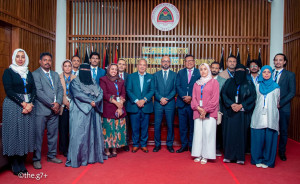
A delegation from the HIKMA Fellowship programme paid a visit to Timor-Leste from September 1st to 4th, 2026, organised by the g7+ Secretariat, to learn about the national experience of transitioning from conflict to peace, reconciliation, and the building of State institutions.
The visit was part of the peer-learning programme promoted by the g7+ through cooperation among countries affected by fragility (Fragile-to-Fragile Cooperation). The initiative received financial support from the Government of the Netherlands and involved the g7+ Secretariat, DeepRoot Consulting, the HIKMA Fellowship, and the Centro Nacional Chega, I.P. (CNC).
The HIKMA Fellowship is a leadership development programme that brings together participants from various sectors of Yemeni society, including current and former civil servants, representatives from civil society, academia, the media, and the private sector, to strengthen their capacities in peace, governance, and development.
Over the four days, the delegation met with political leaders, former government officials, and representatives of national institutions to explore various dimensions of Timor-Leste’s post-conflict experience.
The programme included meetings with the President of the Republic, José Ramos-Horta; the Vice Prime Minister, Coordinating Minister of Economic Affairs, and Minister of Tourism and Environment, Francisco Kalbuadi Lay; the Minister of the Interior, Francisco Guterres; and the Vice-President of the National Parliament, Alexandrino Afonso Nunes.
The delegation also held working sessions with the Chega National Centre, the Ministry of Finance, and the Central Bank of Timor-Leste, as well as other institutions, focusing on reconciliation and transitional justice, security, democratic governance, the management of public finances and natural resources, and economic development.
During the audience with the delegation on September 2nd, 2026, Vice Prime Minister Francisco Kalbuadi Lay emphasised the importance of national leadership, strong institutions, and long-term investment to consolidate stability and development. “National stability and progress require a clear vision, responsible leadership, and a continuous commitment to building democratic institutions,” he stated.
The Vice Prime Minister also highlighted the reconciliation between Timor-Leste and Indonesia as a deliberate, forward-looking decision, made possible by the vision and leadership of Prime Minister Kay Rala Xanana Gusmão. He further noted that elections, coalition government formation, governance under the Constitution, and political dialogue have enabled differences to be managed peacefully through democratic institutions.
Across the various meetings, key lessons from Timor-Leste’s journey were shared, highlighting the role of dialogue and reconciliation, the building and consolidation of democratic institutions, the rule of law, social cohesion, and the management of national resources.
During the audience with the delegation, President José Ramos-Horta stressed that there is no universal model for peace or democracy, and underlined the need for national unity, reconciliation, inclusive leadership, and dialogue in seeking solutions to protracted conflicts.
The Minister of the Interior, Francisco Guterres, addressed the national experience of restoring stability and reforming the security sector, emphasising the need to preserve national cohesion despite differences: “We think differently, but we are all Timorese.”
The visit enabled participants to analyse how lessons from the Timorese experience in peace processes, reconciliation, institution-building, and development can be applied in the context of Yemen.
The programme concludes today with sessions of reflection and dialogue to systematise the key lessons learned during the visit.