





Prime Minister Highlights Education and Training as Pillars of Judicial Reform and of the Rule of Law's Consolidation
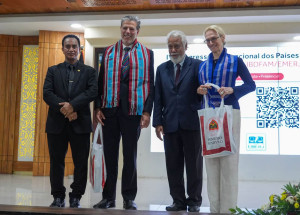
In his closing address at the Fourth International Congress of Portuguese-Speaking Countries—IBDFAM/EMERJ—held on July 10th, 2026, in the Grand Hall of the Ministry of Foreign Affairs and Cooperation in Dili, Prime Minister Kay Rala Xanana Gusmão argued that human resources development, the strengthening of legal culture, and academic cooperation are pillars of justice sector reform and the consolidation of the democratic rule of law in Timor-Leste.
The conference, held for the first time in Timor-Leste from July 8th to 10th, was organised by the Brazilian Institute of Family and Succession Law (IBDFAM – acronym in Portuguese) in partnership with the Rio de Janeiro State School of Magistrates (EMERJ – acronym in Portuguese). It brought together judges, legal experts, academics, and representatives of judicial institutions from various Portuguese-speaking countries to discuss issues related to family law, human rights, the protection of the most vulnerable, and legal cooperation among Portuguese-speaking countries.
During the closing session, Minister of Justice Sérgio Hornai emphasised that, over the course of the three-day event, “Dili was the capital of dialogue and legal reflection,” bringing together representatives from Angola, Brazil, Portugal, and Timor-Leste “to think, together, about building a more just, humane, and inclusive society.” The minister also stressed that “a modern and efficient justice system—which is the system that the Ministry of Justice and the 9th Constitutional Government wish to continue strengthening—is not merely one that employs the best procedures. Above all, it places human dignity at the centre of all its concerns.”
In his remarks, the Head of Government emphasised the importance of academic cooperation among Portuguese-speaking countries, stating that “international partnerships in the academic sphere are essential for the exchange of ideas, experiences, and solutions; for conducting studies and writing scientific articles; and for producing literature that sheds light on the cultural, social, and political realities of each country.” He added that, in the case of Timor-Leste, “cooperation with friendly countries—particularly Portuguese-speaking countries, which have stood by us since our independence—plays an important role in the country’s development process, in which the training of professionals and human resources is fundamental.”
Recalling the nation’s history, Kay Rala Xanana Gusmão emphasised that “the struggle of the Timorese people made possible the creation of a new democratic state governed by the rule of law and paved the way for the building of a society founded on respect for human dignity and the other fundamental principles enshrined in the Constitution of the Democratic Republic of Timor-Leste.” He also noted that the Constitution enshrines values such as self-determination, freedom, equality between men and women, the protection of the family, and respect for human rights.
The Prime Minister also emphasised the importance of the family, noting that “the family is the basic unit of society. It is a fundamental space for protection, love, growth, and learning,” and added that “it is the State’s responsibility to support families in this mission.” He further noted that protecting the most vulnerable requires an adequate legal framework and qualified professionals, stating that “the State has a duty to protect the most vulnerable” and that such protection requires “appropriate laws and trained personnel—particularly in the social and judicial sectors—capable of responding appropriately, swiftly, and fairly, thereby enabling all citizens to exercise their fundamental rights effectively.”
Referring to the Executive Branch’s priorities for the justice sector, the Head of Government stated that “one of my government’s priorities is reforming the justice sector, and an essential part of that reform is training current and future judicial officials so they can identify the real problems and make fair and appropriate decisions.”
Towards the end of his remarks, Kay Rala Xanana Gusmão called on universities, professors, researchers, and students to help prepare future generations, emphasising that “the academic world, professors, and students have a mission of the utmost importance” and that “it is in your hands, I remind you, to shape the new generation of leaders.” He also advocated strengthening legal culture and research in Timor-Leste, noting that “events such as this Congress and the partnership it represents will contribute to strengthening legal culture, a culture of reflection, and a culture of research in Timor-Leste.”
The Prime Minister also highlighted the challenges posed by new technologies and artificial intelligence, calling on young people, teachers, researchers, and academics to promote the study of topics that “contribute to the promotion of justice, the law, human rights, knowledge, and, ultimately, tolerance and collective peace.” He also encouraged the National University of Timor Lorosa'e (UNTL – acronym in Portuguese), the Timorese branch of IBDFAM, and other institutions of higher education and research to foster debates and partnerships that strengthen critical thinking and prepare the country’s future leaders.
Over the course of three days, the Fourth International Congress of Portuguese-Speaking Countries provided a forum for the exchange of experiences among institutions and experts from Portuguese-speaking countries on topics such as the protection of women’s and children’s rights, family relations, civil registration, adoption, domestic violence, consensual methods of conflict resolution, and the protection of the elderly and people with disabilities, thereby contributing to the strengthening of legal cooperation among the participating states.