



The Government Launched the SANUTRIO Conditional Mother's Allowance Programme to Improve Maternal and Child Health and Nutrition
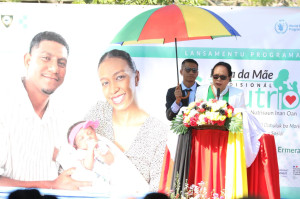
On July 2nd, 2026, the Government, through the Ministry of Social Solidarity and Inclusion, launched the Conditional Bolsa da Mãe (Mother's Allowance) Program for Maternal and Child Health and Nutrition (BdMK SANUTRIO – acronym in Tetum) in Gleno, in the municipality of Ermera. The initiative is designed to improve the health and nutrition of pregnant women, breastfeeding mothers, and children up to three years of age from vulnerable families. The programme is part of the implementation of the 2024–2030 National Multisectoral Action Plan for Nutrition and aims to help reduce child malnutrition in the country.
Timor-Leste remains one of the countries with the highest rates of child malnutrition in the region, affecting approximately 45% of children under five. To address this challenge, the Government approved the 2024–2030 National Multisectoral Action Plan for Nutrition in March 2025, which sets a target to reduce this rate to less than 25% by 2030 through coordinated action across government sectors.
Sponsored by the Ministry of Social Solidarity and Inclusion, in collaboration with the Ministry of Health and the Ministry of Finance and delivered through the National Institute of Statistics of Timor-Leste, the programme also receives support from the Asian Development Bank (ADB) and the World Food Programme (WFP).
The BdMK SANUTRIO coordinates social protection measures with health services by providing financial incentives, distributing specialised nutritional supplements, promoting food and nutrition education, and providing regular follow-up care for mothers and children during the first 1,000 days of life—a critical period for child growth and development.
During the pilot phase, the programme will be implemented in the municipalities of Ermera and Covalima, and in the Special Administrative Region of Oe-Cússe Ambeno (RAEOA), covering approximately 8,500 households. Implementation will be carried out by the Community Health Centres in these regions, which will provide integrated services, including antenatal and postnatal care, monitoring of nutritional status, promotion of breastfeeding, health education, and distribution of nutritional supplements to eligible beneficiaries. The programme also provides a transport subsidy to facilitate access to health services.
To support the initiative's management, a Management Information System will be used to ensure beneficiary registration, monitoring, and payment, thereby strengthening coordination between the social protection and health care systems.
In addition to the Minister of Social Solidarity and Inclusion, Verónica das Dores, and the Vice Minister of Social Solidarity and Inclusion, Céu Brites, the launch ceremony was attended by the President of the Republic, José Ramos-Horta; the Vice Prime Minister, Coordinating Minister for Social Affairs, and Minister of Rural Development and Community Housing, Mariano Assanami Sabino; the Vice Minister of State Administration, Jacinto Rigoberto, representing the Government; and representatives from the Asian Development Bank, the World Food Program, public institutions, development partners, and local authorities.
With the launch of BdMK SANUTRIO, the Government is strengthening the implementation of measures set out in the 2024–2030 National Multisectoral Action Plan for Nutrition, promoting an integrated response to improve maternal and child health and nutrition and to prevent malnutrition among the most vulnerable families.