





BCTL report forecasts 4.6% growth in 2025 and fuels debate on a private-sector-led economy
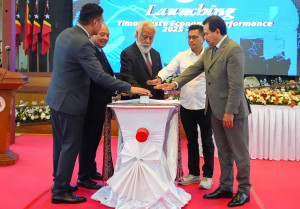
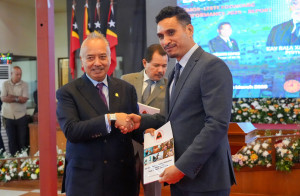
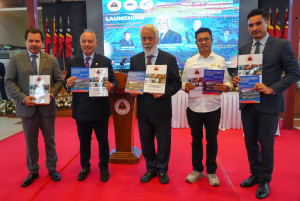
The Report on Timor-Leste’s Economic Performance in 2025, prepared by the Central Bank of Timor-Leste (BCTL) and presented yesterday, March 23rd, 2026, at the Dili Convention Centre, indicates that the national economy has maintained an upward trajectory, with estimated growth of 4.6% in 2025, inflation of 0.5%, and an increase in per capita income to US$1,298. During the event, Prime Minister Kay Rala Xanana Gusmão noted that the document presents “an important snapshot of our current situation” and emphasised the need to use this foundation to accelerate the structural transformation of the national economy.
The report indicates a positive trend compared to 2024, when economic growth was at 4.3%, and forecasts growth of 5% in 2026. Based on the data, the recovery in economic activity was primarily driven by public spending, increases in aggregate consumption, and a modest contribution from the private sector, whose investment grew by over 8% in 2025.
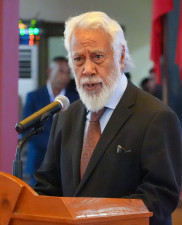
“The Report on Timor-Leste’s Economic Performance for 2025 offers a vital snapshot of our current situation. The question remains, how can we leverage this foundation to reshape our economy and foster private-sector-led growth,” said the Prime Minister.
In his remarks, the Head of the Government highlighted that Timor-Leste has been laying the essential groundwork to enter a new phase of development. He recalled that, after the Restoration of Independence, the country focused on peace, reconciliation, and nation-building, while also making structural decisions for its economic future, such as establishing the Petroleum Fund in 2005.
We have entrusted the management of the Petroleum Fund to our independent Central Bank, which highlights the significance of this major responsibility, and we all recognise and highly value the capabilities of our Central Bank. Since its inception, the Central Bank has managed this Fund with professionalism and transparency,” he said. 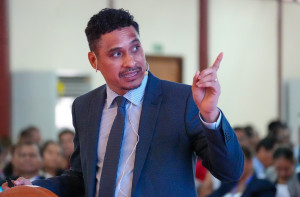

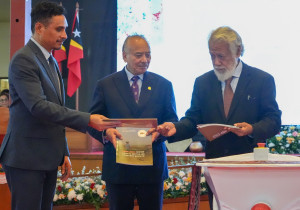
The report’s data show that the Petroleum Fund’s balance reached US$18.61 billion at the end of 2025, up from US$18.27 billion in 2024. The annual return on investment increased to 9.92% in 2025, compared with 7.26% the previous year.
The Prime Minister also emphasised the progress in laying the foundation for development, notably through expanding the electricity grid, building the national road network, developing the port of Tibar, connecting to the undersea internet cable, and planning the renovation of Presidente Nicolau Lobato International Airport.
“We have built a society capable of living in peace and tolerance, with a democratic state that respects human dignity and the rule of law. Compared to many countries around the world that have been self-governing for a long time, our state functions well. Indeed, we have not accomplished everything, but what we have already achieved allows us to continue moving forward. The next step is to build an economy driven by our own sector,” he said.
The BCTL report also notes positive indicators in the financial sector. Total credit reached US$724.4 million in December 2025, deposits amounted to US$1,913.2 million, and the banking system’s total assets reached US$2,936 million. Credit growth and the strength of the financial system are highlighted as key factors supporting private sector development, although the report emphasises the need to expand financing to the most productive sectors.
Helder Lopes, Governor of the BCTL, explained that the report’s presentation focused on two main areas: first, analysing the economic targets set by the Government, and second, assessing the actual performance recorded in 2025. He noted that the objectives set for the term include economic growth of 5% per year, inflation below 4%, annual growth of 10% in private investment, increased domestic revenue, and job creation for young people.
“In light of these key objectives, the BCTL has outlined three strategies to align with the Government’s plan: expanding the credit market, which is vital for the development of the private sector; promoting the digitisation of financial services to support the digitisation of the economy; and promoting financial inclusion to ensure that everyone has access to financial services,” said Helder Lopes.
The governor also observed that the projected 4.6% economic growth for 2025 shows recovery and resilience, despite the challenges faced in recent years.
“Our economy has begun to recover and is showing resilience, but there is one important point to note: between 2022 and 2025, we experienced four economic recessions. Political deadlocks, crises, and external factors caused these recessions. Therefore, we must maintain this positive trend of economic growth and prevent political deadlocks from recurring in the country,” he said.
Among other indicators presented, the report indicates that the average annual inflation rate decreased to 0.5% in 2025, down from 2.1% in 2024 and 8.4% in 2023, which led to an improvement in real household income. Remittances from Timorese living abroad also continued to play a significant role in the national economy, amounting to US$181.9 million in 2025, roughly 10% of GDP.
In the external sector, the report notes an increase in the current account deficit to US$701.4 million, reflecting the ongoing heavy reliance on imports to meet domestic demand. Imports of goods reached US$960 million, with fuel, vehicles, cereals, machinery, and electrical equipment being the main items. At the same time, the report highlights opportunities to strengthen domestic production and import substitution, as well as the growth potential of sectors such as tourism, agribusiness, manufacturing, and services.
Tourism demonstrated promising results, with exports of travel and tourism services expected to reach US$109.6 million by 2025. These figures affirm the sector’s potential to support economic diversification, although improvements are still necessary in infrastructure, connectivity, access to credit, and the regulatory environment.
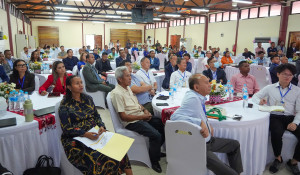
As part of the report’s launch, the BCTL also hosted a dialogue between the Government and the private sector under the theme “Timor-Leste: Toward Private-Sector-Led Economic Growth.” The Prime Minister praised the initiative and called for the continuation of such meetings.
“I commend the BCTL for organising this dialogue. I encourage everyone to take advantage of this opportunity to reflect on how we can move towards a private-sector-driven economy,” he said.
“Everyone should reflect on what they can do. Young people shouldn’t just ask the government what it should do, but rather ask themselves what they can do for the country and its people,” he added.
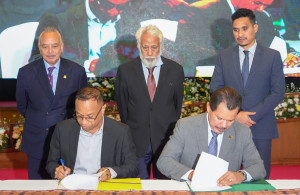
The dialogue led to five joint commitments between the Government and the private sector: structural reform of the business environment, increasing investment in productive sectors, promoting access to finance, easing market access, and institutionalising public-private dialogue. The agreement was signed by the President of the Chamber of Commerce and Industry of Timor-Leste (CCI-TL), Jorge Manuel de Araújo Serrano, and the Minister of Commerce and Industry, Filipus Nino Pereira, in the presence of the Prime Minister, the Vice Prime Minister and Coordinating Minister of Economic Affairs, and the Governor of the BCTL.
The report on Timor-Leste’s economic performance in 2025 confirms the positive trend in key macroeconomic indicators and highlights the importance of continuing efforts to restructure the economy. These include strengthening the private sector, leveraging existing infrastructure, and preparing for new investment opportunities and regional integration.