





Timor-Leste advocates a balanced, inclusive, and rules-based approach to ASEAN's economic security
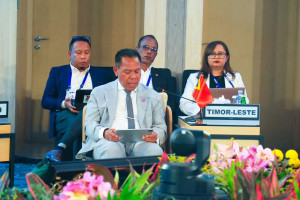
At the ASEAN Senior Economists' Meeting (SEOM) and the 49th High-Level Task Force Meeting on ASEAN Economic Integration (HLTF-EI) in Iloilo on February 25th, 2026, Timor-Leste’s Representative, Vice Minister of Trade and Industry Augusto Júnior Trindade, reaffirmed Timor-Leste's commitment to a balanced, inclusive, and rules-based approach to ASEAN economic security, arguing that resilience should reinforce, not replace, openness and multilateral cooperation.
The position was outlined at the ASEAN Economic Security Roundtable: Context, Considerations, and Challenges, organised by the Philippine Department of Trade and Industry under the theme of the Philippine Chairmanship, “Navigating our future, together,” preceding the 49th Meeting of the High-Level Task Force on ASEAN Economic Integration (HLTF-EI).
In his speech, the Vice Minister noted that the debate on economic security is particularly timely in the context of the global economy's structural transformation.
As a member of ASEAN and the World Trade Organisation, Timor-Leste has argued that economic security should strengthen regional integration and the multilateral trading system. It has emphasised that this concept should not be associated with protectionism but rather understood as a tool to strengthen resilience and ensure the sustainability of economic openness.
During the intervention, Timor-Leste provided three lines of guidance.
Firstly, the need to develop a common and balanced understanding of economic security that supports the multilateral system, preserves ASEAN’s centrality, avoids fragmentation, and recognises differences in development levels among Member States.
Secondly, strengthening institutional coordination across the ASEAN pillars. Economic security is interlinked with areas such as trade, investment, industry, energy, minerals, and foreign policy, requiring coherence between the economic and political-security pillars.
Thirdly, capacity building should be a priority. Implementing strategic trade management systems, export controls, and supply chain monitoring requires an appropriate legal framework, technical capacity, and interministerial coordination. Regional cooperation and technical assistance should ensure that the measures adopted do not widen development disparities.
In sectors such as semiconductors and strategic minerals, Timor-Leste has advocated an approach based on complementarity and sustainable value creation to avoid practices that promote market fragmentation.
Timor-Leste reiterated its willingness to continue working with ASEAN Member States to build an economic security agenda consistent with the principles of regional integration and multilateralism.