





Timor-Leste Strengthens Commitment to Social Protection and Nutrition at Second World Summit for Social Development in Qatar

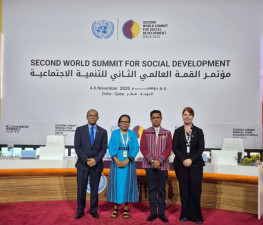
The Government of Timor-Leste, represented by Vice - Prime Minister and Minister for Social Affairs Mariano Assanami Sabino and Minister for Social Solidarity and Inclusion Verónica das Dores, participated in the Second World Summit for Social Development, held in Doha, Qatar, from November 4th to 6th 2025, which marked the 30th anniversary of the 1995 Copenhagen Summit. The delegation was supported by the Permanent Representative of Timor-Leste to the United Nations, Ambassador Dionísio da Costa Babo Soares, and the World Food Programme (WFP). 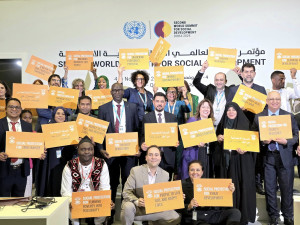

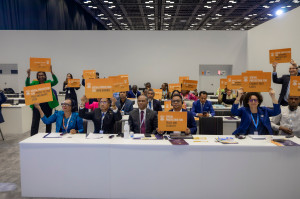

Organized by the United Nations, the Summit brought together representatives from more than 150 countries to renew the global commitment to poverty eradication, decent work and social inclusion, in a context marked by persistent inequalities and emerging global challenges.
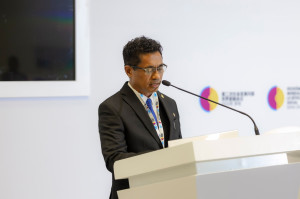
In his speech to the plenary session, the Vice - Prime Minister emphasized the central role of people in national development and stated that social protection systems should be seen as an investment in peace, human dignity and sustainable development. He also highlighted the role of Timor-Leste as Chair of the Global Taskforce on Social Protection and Nutrition, a platform that brings together vulnerable countries with the aim of transforming political commitments into concrete actions to support the most disadvantaged populations.
Timor-Leste also presented the progress made in addressing malnutrition, recognized as a national priority, through initiatives such as the Conditional Mother's Grant programme, which links cash transfers to nutritional monitoring and women's empowerment, with the support of international partners.
The Vice - Prime Minister also highlighted three lessons learned from the Timorese experience: first, the social protection should be seen as an investment rather than a cost; secondly, the international cooperation is essential to promote innovation and sustainable financing; and finally, it is essential to bring global financial mechanisms closer to local realities, ensuring that all children have access to food and protection.
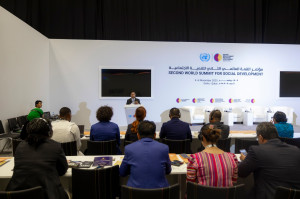
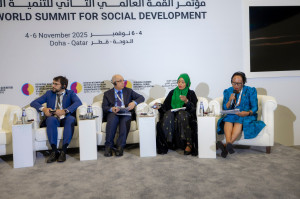
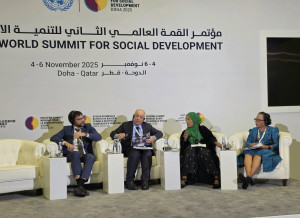
On the sidelines of the Summit, Timor-Leste co-organized, together with Iraq, the WFP, the ILO, UNICEF, IDS – University of Sussex and the European Union, the high-level side event “From Reform to Impact: Governments Paving a New Era of Universal Social Protection for Food and Nutrition Security”, which brought together representatives from Timor-Leste, Iraq, Brazil and Somalia. The session was opened by Vice - Prime Minister Mariano Assanami Sabino.
During the panel, the Minister of Social Solidarity and Inclusion presented the national experience in implementing the Conditional Mother's Grant for Maternal and Child Health and Nutrition programme (Bolsa da Mãe Kondisional ba Saúde Nutrisaun Inan no Oan - BdMK-SANUTRIO), highlighting its contribution to the prevention of stunting and the improvement of maternal and child health.
In the question-and-answer session, the Minister was asked how to ensure that vulnerable populations are effectively included in social programs. In response, she stated that “leadership has a responsibility to be close to families to identify and understand the challenges they face, through home visits and direct monitoring, ensuring that no one is left behind.”
The event reinforced the commitment of participating countries to promote inclusive, evidence-based policies and to deepen regional and South–South cooperation for sustainable social protection systems.
Timor-Leste's participation in the Summit and parallel debate demonstrated the country's commitment to consolidating universal, resilient and people-centered social protection systems, reinforcing Timor-Leste's role as an active voice in advocating for nutrition, food security and social protection.