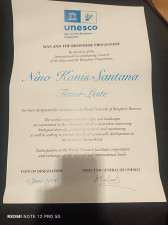
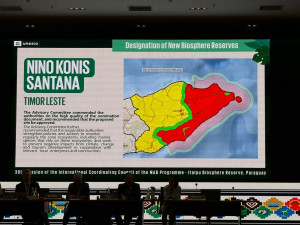
Nino Konis Santana National Park was officially designated Timor-Leste’s first Biosphere Reserve at the 38th session of UNESCO’s International Coordinating Council of the Man and the Biosphere (ICC-MAB) Programme, held in Hernandarias, Paraguay, from June 3rd to 6th, 2026. The Timorese delegation was led by Fernandino Vieira da Costa, Secretary of State for Forests, representing the Government of Timor-Leste.
With this decision, the Nino Konis Santana Biosphere Reserve has joined the UNESCO World Network of Biosphere Reserves, marking a milestone in nature conservation and in the international recognition of Timor-Leste’s natural heritage.
In his speech to the members of the Man and the Biosphere Programme Council, the Secretary of State for Forests thanked UNESCO and its partners for their support throughout the application process and emphasised that this designation is “a testament to Timor-Leste’s firm commitment to the protection of biodiversity, the sustainable management of natural resources, and the promotion of development that harmonises nature with the lives of local communities.”
The Secretary of State also emphasised that “the active involvement of local communities in the management of natural resources is the cornerstone of long-term sustainability” and advocated integrating traditional knowledge and cultural heritage into modern conservation practices.
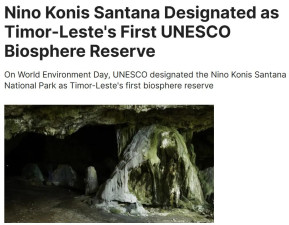
Located in the municipality of Lautém, the Nino Konis Santana Biosphere Reserve encompasses terrestrial, coastal, and marine ecosystems, including tropical forests, wetlands, coral reefs, and seagrass beds, within the Coral Triangle, one of the planet’s most biodiverse regions. The area also holds significant cultural heritage and reflects the historical relationship between local communities and the environment.
According to UNESCO, the classification is the result of cooperation between the Government of Timor-Leste, the National Commission of Timor-Leste for UNESCO, the Municipality of Lautém, and the UNESCO Regional Office in Jakarta, with support from the Government of Japan for baseline studies and technical analyses.
Maki Katsuno-Hayashikawa, Director of the UNESCO Regional Office in Jakarta and Representative to Timor-Leste, said that this designation “is a moment of pride for Timor-Leste” and recognises the efforts of national authorities, local communities, and partners to protect biodiversity, promote sustainable livelihoods, and preserve cultural heritage. 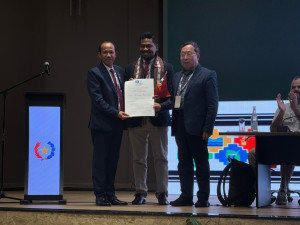
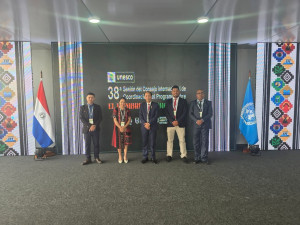
During his visit to Paraguay, the Secretary of State for Forests also took part in technical, and exchange visits organised by UNESCO to the Itaipu Biosphere Reserve and the Tekotopa Environmental Centre, which were aimed at sharing experiences in biodiversity conservation, scientific research, environmental education, and sustainable development.
The inclusion of Nino Konis Santana National Park in the World Network of Biosphere Reserves creates new opportunities for international cooperation, scientific research, sustainable tourism, and climate change adaptation, reinforcing Timor-Leste’s commitment to preserving its natural heritage and ensuring sustainable development for future generations.