Last November, a Timorese government delegation took part in a regional interdisciplinary training course focused on integrating Disaster Risk Reduction (DRR) and Climate Change Adaptation (CCA) into national planning and budgeting processes, aiming to promote more resilient and sustainable development.
The training took place in Bangkok from November 25 to 28, 2025, bringing together government representatives from Timor-Leste, the Maldives, and the Seychelles, including officials from national disaster management authorities, climate change services, finance ministries, planning agencies, and key sectors such as infrastructure, urban development, and land use planning. Organised by the United Nations Development Programme (UNDP), the initiative is part of the project to embed disaster risk reduction and climate adaptation into risk-informed development (RID). 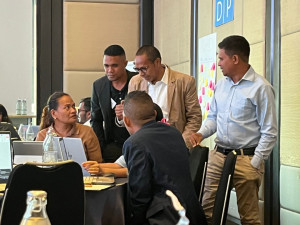
The Timor-Leste delegation consisted of representatives from the National Planning Directorate of the Ministry of Finance, the Ministry of Tourism and Environment, the Office of External Relations and Communication of the Civil Protection Authority, the National Directorate for Support to the Implementation of Integrated Planning and Development within the Ministry of State Administration, the National Directorate for Road Maintenance and Conservation of the Ministry of Public Works, and the National Geospatial Data Centre and the Ministry of Planning and Strategic Investment. 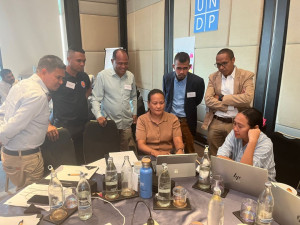
The Risk Informed Development (RID) Focal Point for Timor-Leste for the Civil Protection Authority, Mateus da Costa, emphasised the importance of “integrating disaster risk reduction and climate adaptation into ongoing planning and budgeting processes, with a view to strengthening the State’s response capacity and protecting populations”.
During the training, the significance of an integrated, multisectoral, and risk-based approach was highlighted, acknowledging that disaster risk reduction, climate adaptation, and sustainable development are interconnected aspects. One of the trainers, Angelika Planitsk, from the UNDP’s Disaster Risk Reduction and Recovery Unit, stated that “climate change and disasters are among the greatest challenges to sustainable development in the 21st century,” arguing that these areas “are not separate issues, but deeply interconnected and mutually reinforcing.” 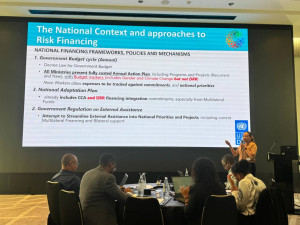
The practical aspect was central throughout the training, with the Timor-Leste delegation presenting contributions on risk governance and financing mechanisms aimed at disaster and climate change resilience, currently being developed in the country. On the final day of the workshop, after an internal review of national systems and the identification of gaps and opportunities, each delegation presented a first draft of a national action plan with specific next steps for incorporating Disaster Risk Reduction and Climate Change Adaptation into development planning and budgeting processes. 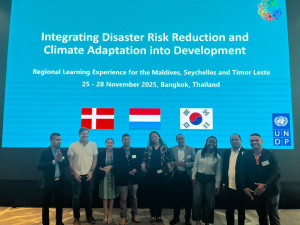
The initiative also reinforced the importance of cooperation among Small Island Developing States, encouraging the sharing of experiences and solutions to common vulnerabilities, as well as a collective commitment to embed resilience into development strategies and policy-making.
Financial support for the training was provided through the UNDP Funding Window on Governance, Peacebuilding, Crisis, and Resilience, with contributions from our partners in the governments of Denmark, Luxembourg, and the Republic of Korea.